Would you like to arrange a meeting? Contact us through our website.
Series · 4 of 4
Your data already feeds campaigns, recommendations and artificial intelligence agents. But what guides their decisions about each customer?
In this video
- The challenge is to connect campaigns, recommendations and agents with a shared view of portfolio priorities: that is the intelligence layer Radar provides.
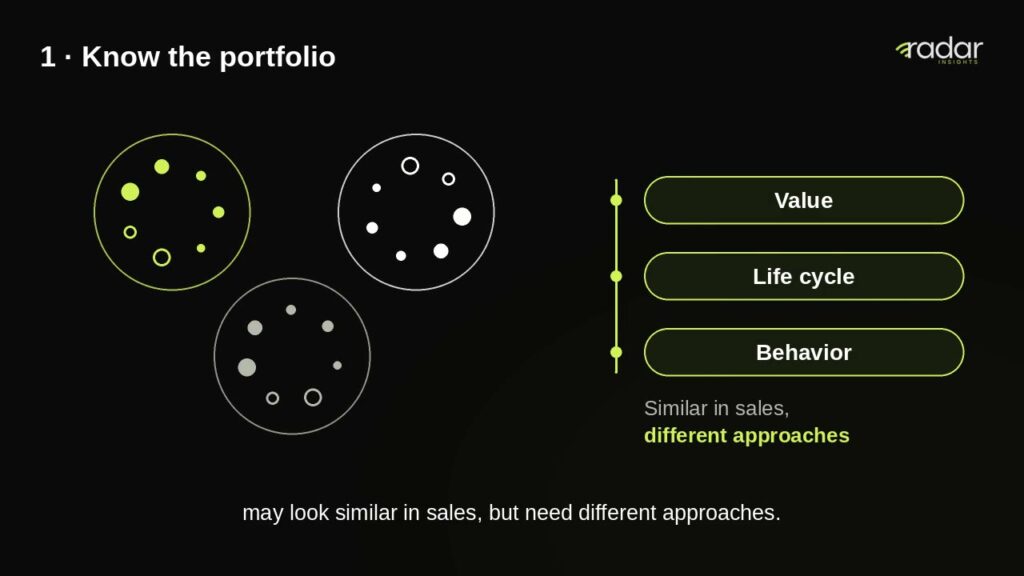
- 1 · Know the portfolio: value, lifecycle and purchasing behavior.
- 2 · Identify priorities: concentration, risks and opportunities, in a diagnostic to discuss where to focus attention and resources.
- 3 · Guide execution: a targeting playbook with whom to address, with what objective, at what moment and with what priority.
- Artificial intelligence and specialized human judgment across the whole chain; your company decides and executes.
Transcript
Your data already feeds campaigns, recommendations, and artificial intelligence agents. But what guides their decisions about each customer? Personalizing an interaction does not, on its own, resolve which relationships to care for or where to develop more value. One campaign seeks conversion. Another tries to reactivate customers. An agent recommends products. Each action can make sense.
The challenge is to connect them to a shared view of the priorities of the portfolio. That is the intelligence layer Radar provides. First, getting to know the portfolio. We organize and enrich the data to understand the value, the life cycle, and the purchase behavior. This is how we distinguish segments and relationships that may look similar in sales, but need different approaches. Second, identify priorities.
We analyze the composition and the evolution of the portfolio to recognize concentration, risks, and opportunities. We do not just describe what happens: we build a diagnosis to discuss where to concentrate attention and resources. Third, guide the execution. We translate the diagnosis into a targeting playbook: who to direct each proposal to, with what objective, at what moment, and with what priority.
A guide for your campaigns, your teams, and your agents, with criteria to evaluate the results. Across the whole chain, we combine artificial intelligence with specialized human judgment. Agents expand the capacity to organize, research, and plan. Consultants bring in the business context, question the interpretations, and answer for the recommendations. Your company decides and executes.
The Radar effect is not about running more campaigns. It is about giving them a shared direction, connecting opportunities relevant to the customer with the business objectives. Let’s arrange a meeting through the link in this profile or through our website. Radar Insights. Where Data Becomes Strategy.
Where does your portfolio need more attention?
If these ideas apply to your business, let’s talk.
Request an introductory presentation