Would you like to arrange a meeting? Contact us through our website.
Segmentation and targeting
To maximize the value of a customer portfolio, you need to know how that value is distributed and where the potential lies. This video explains the matrix Radar builds and what your company receives.
In this video
- Two readings of every customer: value (realized contribution and estimated future value, in four tiers: Bronze, Silver, Gold and Platinum) and lifecycle (Activation, Development, Retention, Action and Recovery).
- Five strategies, one shared goal: increase the value of the portfolio.
- From purchase records to enriched customer data with indicators, estimates and classifications.
- How to track the evolution of the portfolio with the right indicators and comparisons.
- Where to act: the targeting plan defines the priority audiences, the objective of each action, the recommended actions and how to evaluate the results.
- Three deliverables: enriched customer data for the CRM, a diagnostic report and a targeting plan.
Transcript
To maximize the value of your customer portfolio, you need to understand how that value is distributed and where there is potential to grow it. Total sales don’t show that. You need to know the value of each customer, where they are in their relationship with the company, and the opportunities to act. Radar builds that map to guide where to focus your efforts.
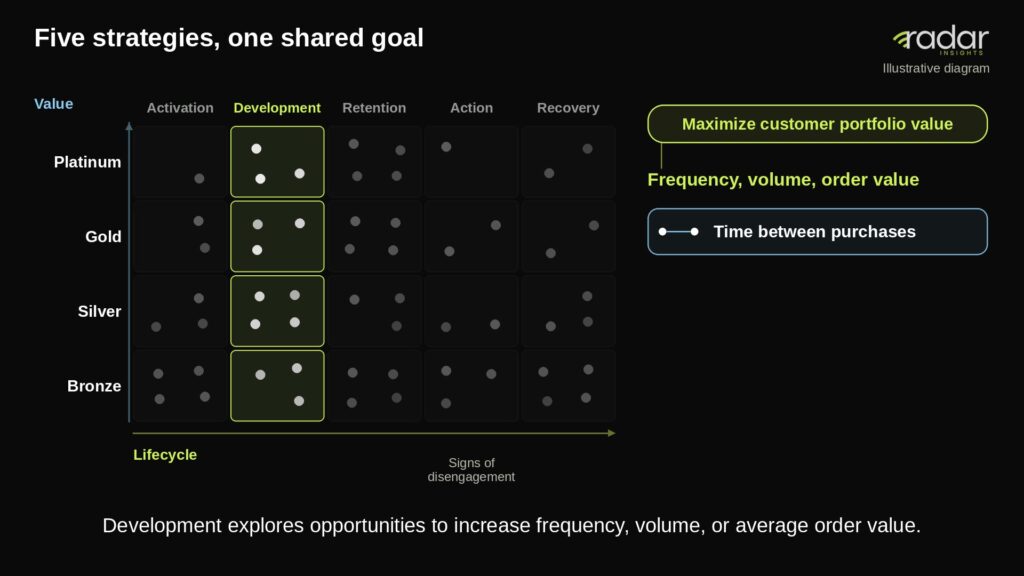
We cross two readings of each customer. On the value axis, we look at realized contribution and estimated future value, organizing the portfolio into four tiers: Bronze, Silver, Gold, and Platinum. On the lifecycle axis, we identify where the customer is in the relationship and the matching strategy: Activation, Development, Retention, Action, or Recovery. Together, these dimensions separate the objective of each initiative from its economic priority.
All five strategies contribute to increasing the value of the customer portfolio. Activation seeks to establish continuity in purchases. Development explores opportunities to increase frequency, volume, or average order value. Retention works to sustain relationships and preserve their future value. Action addresses signs of disengagement. And recovery seeks to restore interrupted relationships. The shared goal is to capture the potential of each relationship, with proposals that are relevant to the customer and a return for the company.
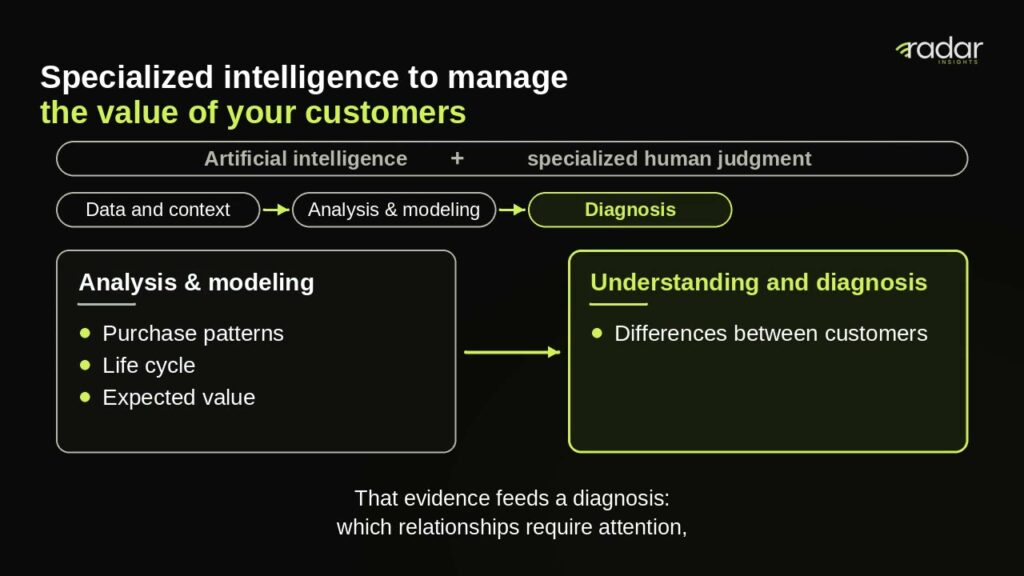
This work starts with purchase records: customer ID, date, and amount. We enrich that data with indicators, estimates, and classifications that the company hasn’t organized yet. With more context, we dig into other questions: how the customer buys, what they look for, who they are, and why they buy. That lets us identify, within the matrix, groups that deserve different approaches. Our consultants guide the research, with models and agents that support processing and analysis.
The map also lets us track how the portfolio evolves. Are customers moving from activation to development? Are we keeping the highest value relationships? Are frequency and average order value growing? Where are signs of disengagement showing up? And how is value distributed across the groups? With the right indicators and comparisons, we identify what is working, what is losing strength, and where there is room to improve.
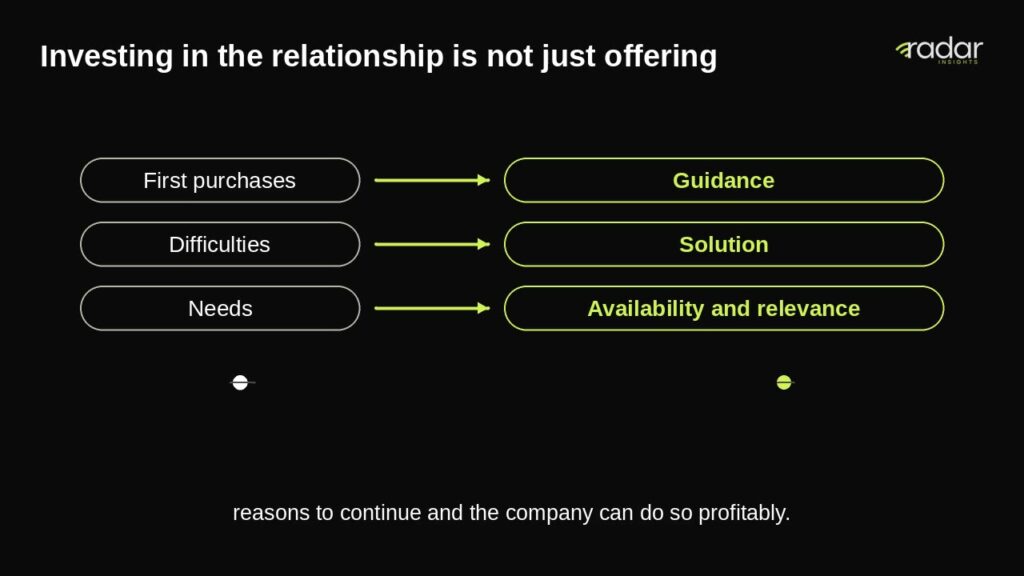
Based on this reading, we assess where to act to increase the value of the customer portfolio. One group may show opportunities for complementary purchases. Another may need attention to preserve a valuable relationship. In other cases, we need to investigate a barrier before proposing a campaign. The targeting plan defines the priority audiences, the objective of each initiative, the recommended actions, and how to evaluate the results.
Your company receives enriched customer data to feed the CRM and its analyses. A diagnostic report to decide priorities and allocate resources. And a targeting plan to guide campaigns and commercial initiatives. This is how Radar combines customer knowledge, specialized analysis, and practical recommendations, to help your company maximize the value of its customer portfolio. Let’s talk.
Where does your portfolio need more attention?
If these ideas apply to your business, let’s talk.
Request an introductory presentation